
Company Registration
Starting & Operating a Business in Mongolia: Company Registration Guide
Welcome to Mongolia! Foreign investors can establish a Private Limited Company, Public Limited Company, Partnership, or Representative Office.
Note: A Private Limited Company with 25% or more foreign ownership is classified as a Foreign-Invested Company (FIC) and requires a minimum capital contribution of USD 100,000 per investor.
Step: Get Your “F Register”
Before starting registration, all foreign individuals need a 13-digit F Register number:
- In Mongolia: Check via the e-Mongolia app (“Check my F register”) or visit the Immigration Agency of Mongolia.
- From Abroad: Email your passport photo to Support@immigration.gov.mn to request your F Register.
Option A: Registering a Foreign-Invested Company (FIC)
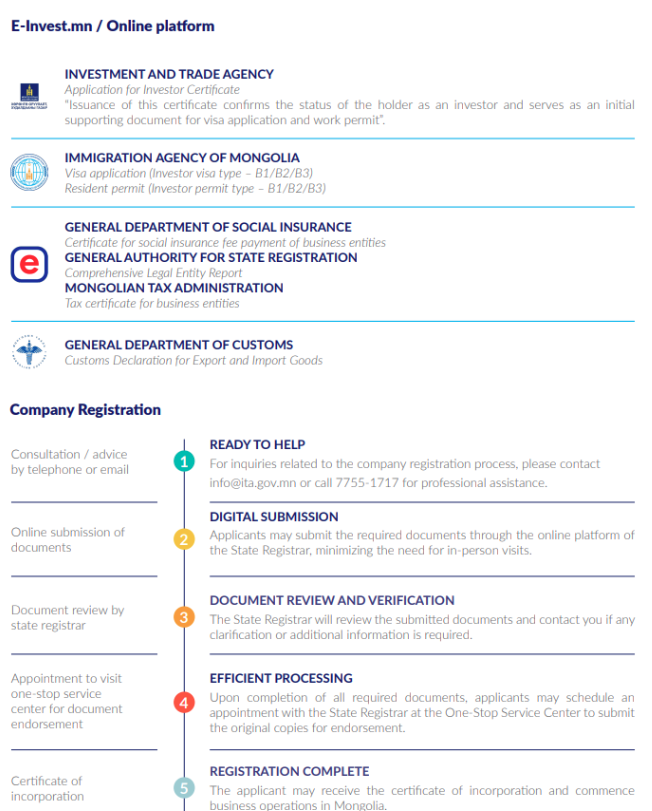
To make registration convenient, you can initiate the process online at e-business.mn, upload your documents for review, and submit the hard copies in person at the One-Stop Service Center.
Checklist of Required Documents:
- Application Forms: UB-03 & UB-12 forms.
- Company Name Verification: Verify online via eng.burtgel.gov.mn or e-business.mn (Valid for 30 days).
- Receipts for Fees:
- Name verification fee: MNT 10,000
- Seal registration fee: MNT 10,000
- State registration stamp duty: MNT 750,000
- Temporary Bank Account: Opened at a local commercial bank using the verified company name.
- Founders’ Decision / Resolution: Signed by founders; includes business scope, address, share capital, and Executive Director appointment. (If the founder is a corporate entity, attach its incorporation certificate and charter).
- Company Charter: 2 copies in Mongolian, 1 copy in a foreign language.
- Founders’ Agreement: Required if there are 2 or more founders (Notarized).
- Proof of Investment: Minimum USD 100,000 (or equivalent MNT) per investor (Bank swift transfer advice, customs declaration, or asset evaluation certificate).
- Proof of Address: Office lease agreement.
- Passport Copy: Copy of passport(s) of authorized investor(s).
Option B: Registering a Representative Office
A Representative Office protects the parent company’s interests and performs legal transactions on its behalf in Mongolia.
Checklist of Required Documents:
- Application Form: UB-04 form.
- Payment Receipts: Stamp duty MNT 1,100,000 + Seal fee MNT 10,000.
- Parent Company Documents: Certificate of Incorporation & Charter of the foreign legal entity.
- Resolution: Decision to establish a representative office, appointing the Head of the office, and adopting internal regulations.
- Internal Regulations: 2 copies in Mongolian, 1 copy in a foreign language.
- Passport Copy: Copy of passport & F Register of the Head of the office.
- Proof of Office Address: Property certificate or lease agreement.
Important Document Rules
- Translation: All foreign documents must be translated into Mongolian by a certified translator.
- Authentication: Documents issued abroad must be notarized and bear an Apostille stamp or be legalized by a Mongolian Embassy/Consulate.
Post-Registration & Mandatory Updates
- Tax & Social Insurance: Once incorporated, immediately register with the respective local Tax Office and Social Insurance Office.
- Corporate Changes: Any changes in company name, address, share capital, shareholders, or ultimate beneficial owner (UBO) must be registered with the General Authority for State Registration (GASR) within 15 business days.