Investment Opportunities: Digital Transformation
A government-backed modernization of payments, an open licensing framework and early foreign backing create entry points across Mongolia’s digital finance value chain.
2022–2026
National Payment System Strategy of the Bank of Mongolia
2017 law
National Payment System Law lets non-bank entities take part in payments
USD 21.4 million
Series B raised in 2025 by digital lender AND Global
Vision 2050
Long-term national strategy that emphasizes digitalization
A policy-backed push
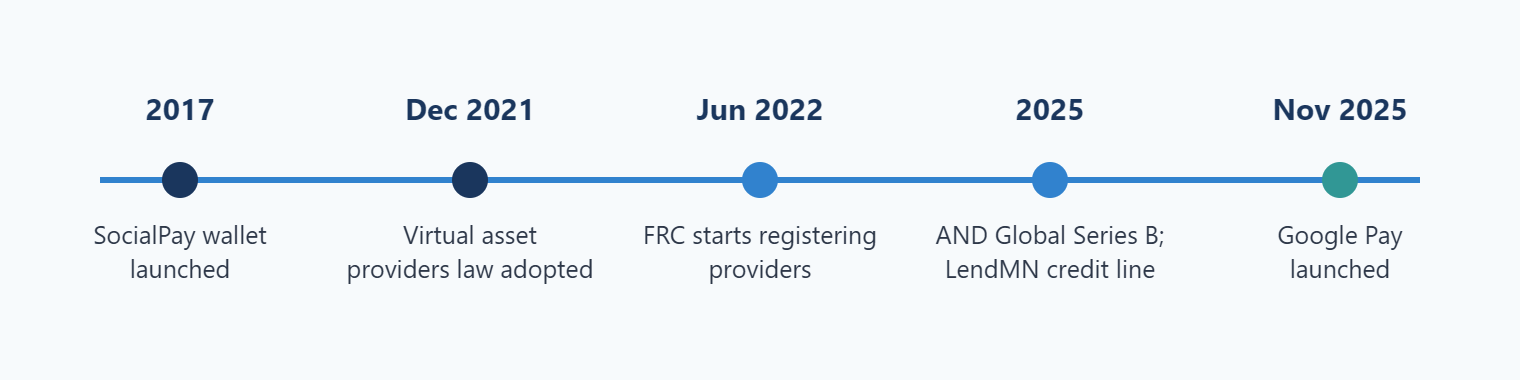
The Bank of Mongolia’s National Payment System Strategy for 2022–2026 sets out a vision of increasingly digital, resilient and secure payments, supported by institutions that promote competition, innovation and inclusiveness. The National Payment System Law, approved in 2017 and in effect from 2018, allows non-bank entities to participate in the payment system, so fintech firms now compete directly with banks. Infrastructure has been upgraded in step: the large-value payment system in 2017, a payment tokenization system for secure mobile payments in 2022, and a modern core banking system at the central bank in 2023. Mongolia’s Vision 2050 strategy also emphasizes digitalization as part of national development.
Where the opportunities are

Opportunity areas
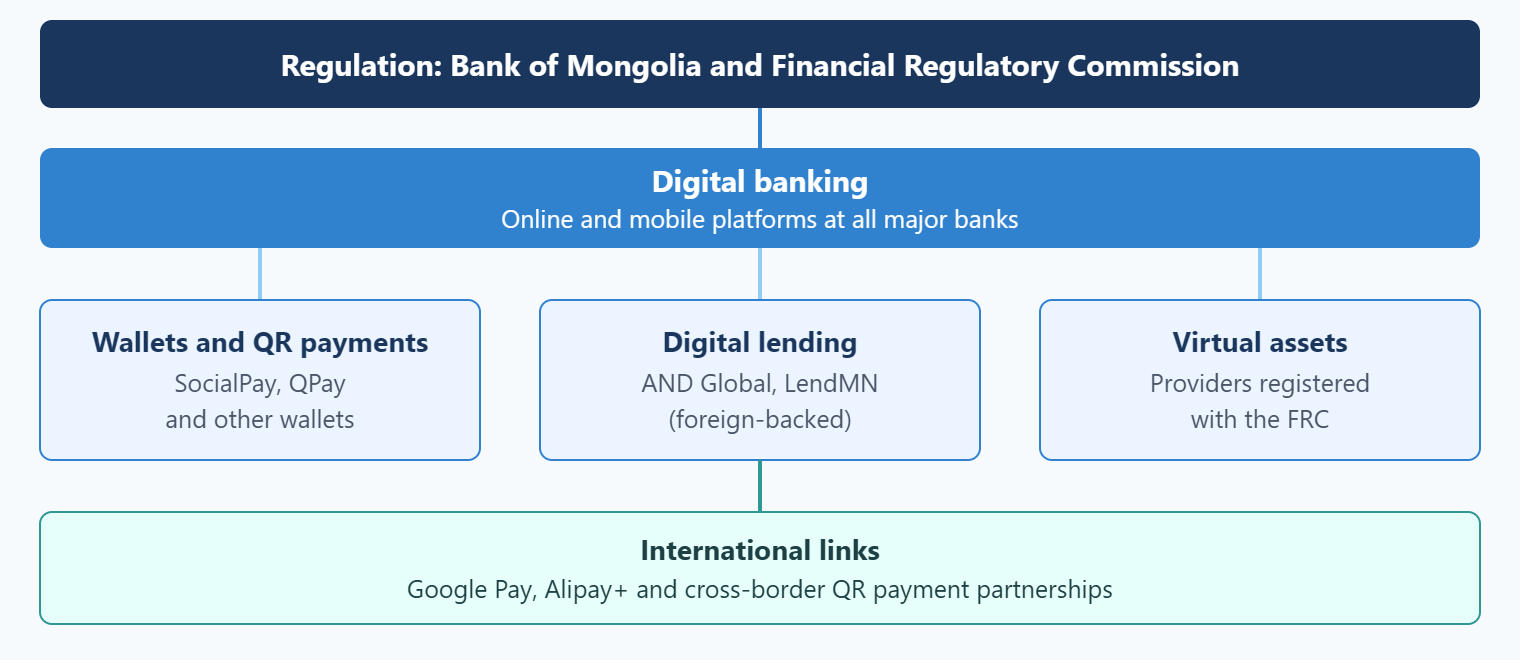
The table above summarizes five areas. Payments and wallets are open to licensed providers, and the central bank issues payment service licences. Digital lending is the area with the clearest foreign backing. Open banking and API services are growing as the large banks, notably Golomt Bank, expand API-driven services and fintech integration. Virtual asset service providers can register with the Financial Regulatory Commission under a dedicated law, and the banks’ and central bank’s own system upgrades create demand for core banking, data and security technology.
Payment system modernization milestones

Foreign capital is already moving in
International investors have begun to back the sector. AND Global raised USD 21.4 million in 2025 in a round led by the International Finance Corporation and AEON Financial Service, the digital lender LendMN arranged a credit line of up to USD 20 million from Lendable, and Google Pay launched in Mongolia in November 2025. These transactions suggest that investors can enter through minority equity, credit facilities or commercial partnerships with established local players.
Risks and entry approach
The domestic market is small, and several established wallets already compete for the same users. The current payment strategy runs only to 2026, so investors should watch for the next policy cycle and any licensing changes. Fast-growing digital lending requires careful credit-quality and compliance checks and digital finance depends on trust and cyber resilience. A practical approach is to start with a partnership or minority stake alongside a licensed bank or payment provider, confirm licensing requirements with the Bank of Mongolia or the FRC, and take local legal advice before committing capital.
Why it matters for foreign investors
Clear licensing routes, a modernized payment backbone and early backing from international investors make digital finance one of the most accessible entry points into Mongolia’s financial sector.
Sources: Bank of Mongolia, Payment System Strategy 2022-2026, payment system modernization timeline, National payment system overview and Google Pay launch; The Fintech Times, Fintech Landscape of Mongolia in 2026 and Mongolia’s Fintech Future; GRATA International, virtual asset service providers; Business Info, LendMN credit line.