Strategic Deposits
Sixteen designated deposits anchor Mongolia’s mining sector. Each carries its own ownership rules, which makes deposit-by-deposit due diligence essential for investors.
16
Deposits currently designated as strategic
5% of GDP
Production level that can qualify a deposit as strategic
50% / 34%
Maximum state equity: state-funded / privately funded exploration
51%+
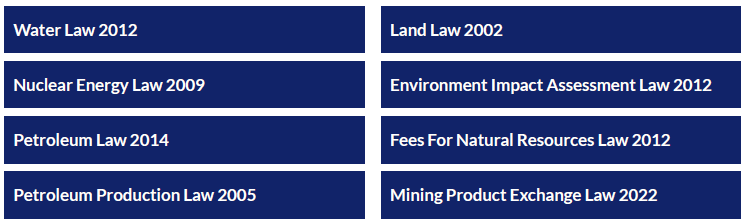
State share required in uranium joint ventures under the Nuclear Energy Law
What makes a deposit strategic
Mining is the cornerstone of the Mongolian economy and supplied about 92% of exports in 2023. Within the sector, Parliament can designate a deposit as strategic when it meets any one of three tests under the Minerals Law: it may affect national security, it may influence economic and social development at the national or regional level, or it produces, or could produce, more than 5% of GDP in a given year.
State participation: from equity to royalty
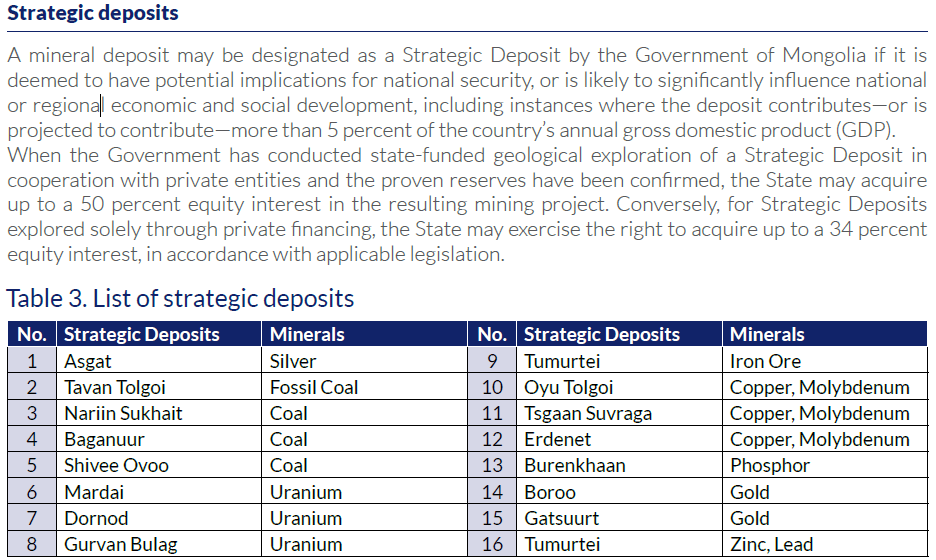
Under the Minerals Law, the State may take an equity stake of up to 50% in a strategic deposit whose reserves were proven through state-funded exploration, or up to 34% of the investment where exploration was privately financed. The April 2024 amendments, adopted together with the Sovereign Wealth Fund Law, tightened the rules by capping any single shareholder at 34% of a strategic license holder. Since January 2025, the State’s equity interest can be replaced by a special royalty payment, giving investors an alternative to giving up equity.
Key commodities and designated assets
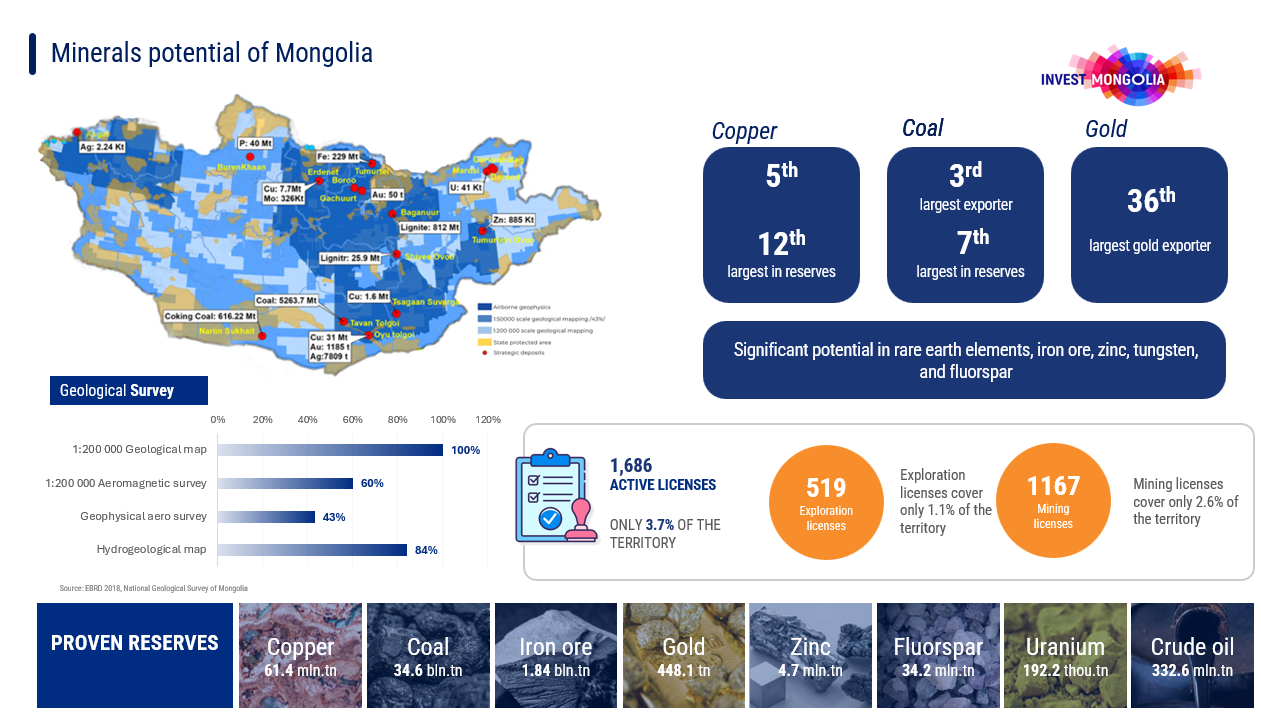
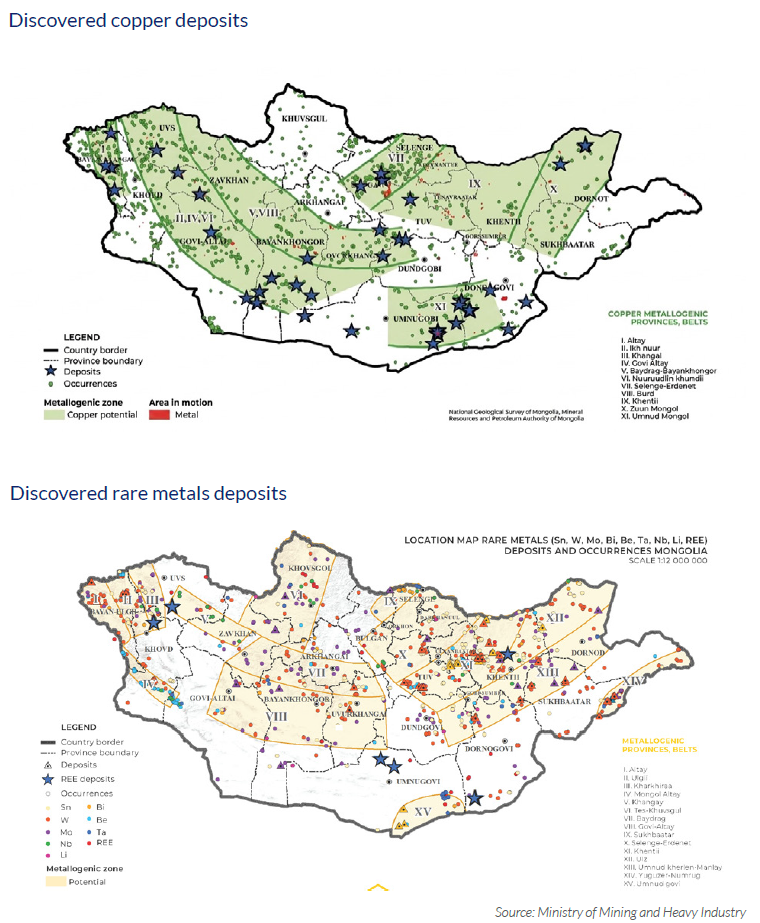
The 2007 parliamentary list named 15 deposits, and the current count is 16. They span copper and molybdenum, coal, uranium, gold, iron ore, zinc, silver and phosphate. Copper and molybdenum are led by Oyu Tolgoi, Erdenet and Tsagaan Suvarga, and Oyu Tolgoi is owned 66% by Rio Tinto and 34% by the State. Coal includes Tavan Tolgoi, Nariin Sukhait, Baganuur and Shivee Ovoo. The uranium deposits are Mardai, Dornod and Gurvan Bulag, the gold deposits include Boroo, and the remaining deposits are Tumurtei (iron ore), Tumurtein Ovoo (zinc), Asgat (silver) and Burenkhaan (phosphate).
Designated strategic deposits by commodity

Strategic deposits at a glance

What this means for investors
Ownership differs sharply from one deposit to the next. Oyu Tolgoi is a joint venture with the State, Erdenet is a Mongolia-Russia joint venture, Tavan Tolgoi is developed by a state-owned company, Tsagaan Suvarga is in private hands, and the uranium deposits are not yet producing, partly because the Nuclear Energy Law requires the State to hold at least 51% of a joint company. The list can also grow: the government has considered designating eight more deposits, including Kharmagtai, Bayan Khundii and Altan Nar. Investors should therefore confirm a deposit’s status, its existing agreements and the applicable state share before committing capital.
Strategic orientation and Vision 2050
Mongolia’s long-term policy, Vision 2050, aims to diversify the economy beyond mining, and the government has pointed to adding value domestically as a goal for the sector. Infrastructure is advancing: a new railway linking the Tavan Tolgoi coal mines to the Chinese border at Gashuun Sukhait began operating in September 2022. Rare earths remain at an early stage, with about 80 occurrences identified but no active mines or processing plants as of 2022.
Why it matters for foreign investors
Strategic deposits hold Mongolia’s largest resources, and the 2025 royalty option, the 34% cap and deposit-specific ownership rules make early legal review the key step in any entry.
Sources: Minerals Law of Mongolia (2006 text); USGS Minerals Yearbook, Mongolia, 2023 and 2022; PwC Mongolia, Corporate tax summaries; Mongolian Journal of International Affairs, strategic deposit list; Mongolian Mining Journal, deposits of strategic importance; News.MN, proposed strategic deposits; East Asia Forum, Mining drives Mongolia’s economy. *Gatsuurt is included in the count of 16 but was not among the 15 deposits on the 2007 list.