Agribusiness Sector Overview
A herding economy with growing meat and cashmere exports, rising wheat output and a processing industry that is still small, which is where the investment opportunity lies.
58.1 million
Head of livestock at the end of 2025
USD 343.9 million
Meat and meat product exports in 2025
USD 330.6 million
Combed cashmere exports in 2025
18–27%
Share of workers in agriculture, depending on the source
The role of agribusiness
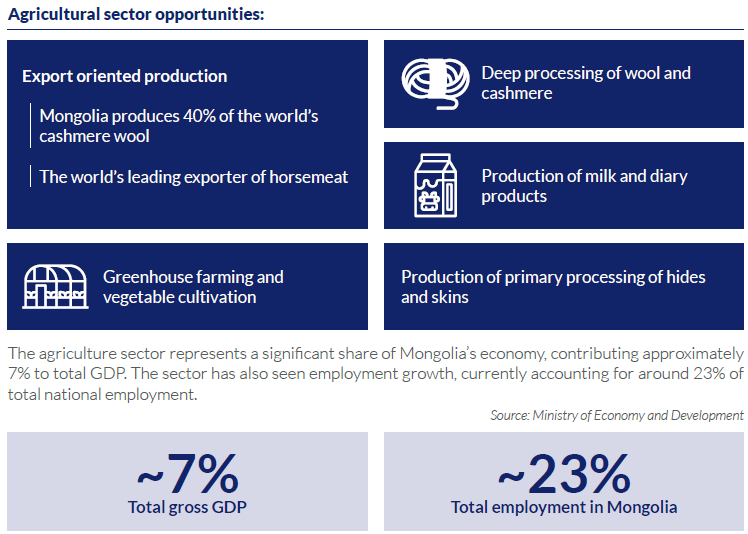
Mongolia’s steppe supports one of the world’s largest pastoral livestock economies, and agricultural land covers about 69% of the country. Agriculture is much smaller than mining, which supplied 92.1% of exports in 2023, but it is one of the largest employers and the main route to economic diversification under Vision 2050. Its share of GDP is reported at about 7.5% in 2024, although some sources give a higher figure, and output swings sharply with the weather.
Livestock and weather risk
Livestock is the core of the sector. A severe winter cut the national herd by about 7 million animals, or 10.9%, to 57.6 million in 2024, and agricultural output fell 28.7% that year. Output then recovered strongly, with growth of 33.8% year on year in the third quarter of 2025, and the herd reached 58.1 million by the end of 2025. Pastures remain under strain: officials estimate that grazing land carries the equivalent of 25 million head of livestock more than it can sustain.
Livestock numbers

Exports and value addition
Exports are growing. In 2025 Mongolia exported 85,400 tons of meat and meat products worth USD 343.9 million, and about 67 meat processors held special export licenses. Combed cashmere exports reached about 4,000 tons worth USD 330.6 million. Since a technical regulation took effect in February 2025, cashmere has been exported in combed rather than washed form, and the combed product sells at a border price 1.8 times higher. Cashmere, wool, other fibers and hides together make up about 35% of non-mining exports. Most agricultural exports still leave after only primary processing, so adding value is the main opportunity.
Segments at a glance

Crops and food security
Wheat is the main crop. The government plans to expand the sown area of wheat and vegetables from about 400,000 hectares toward 1 million, and the 2025 plan aimed to meet domestic flour demand from the domestic wheat harvest. Drought affected about 70% of the country in 2025, though, and the total harvest fell 40.3% from the year before, to 745,100 tons including 252,300 tons of wheat. Mongolia also imports much of its dairy, and egg and poultry production is limited, which leaves gaps for domestic producers.
What this means for foreign investors
The clearest openings are in meat processing and cold-chain exports, combed cashmere and fiber processing, dairy processing, poultry and egg production, and flour and food processing. Export demand is proven, and the government is encouraging higher-value output over raw exports. Investors should weigh the weather risk, pasture limits, the small domestic market and the quarantine rules that can restrict meat exports, and they should confirm export licensing and current rules with the Ministry of Food, Agriculture and Light Industry and take local legal advice before committing capital.
Why it matters for foreign investors
Mongolia has a large herd, rising export revenue and little domestic processing, so investors who bring processing capacity and technology can capture value that is now lost in raw exports.
Sources: East Asia Forum, Mining drives Mongolia’s economy; Ministry of Food, Agriculture and Light Industry data via MTS and News.az; Xinhua via APP; Bank of Mongolia, non-mining export presentation; DairyNews, livestock census 2024; Ministry of Economy and Development, macroeconomic report; Ikon.mn, 2025 harvest; UkrAgroConsult, Mongolia flour demand and pastures; Dutch Ministry of Foreign Affairs, Agrifood opportunities in Mongolia; KOPIA, wheat area policy.